Category: dai11y

Accessibility themed newsletter: get your daily dose of a11y.

  • dai11y 02/03/2021

    Your daily frequent11y newsletter, brought to you by @ChrisBAshton:

    How we created a reporting tool to improve the accessibility of GOV.UK

    • Avision Ho, a data scientist at GDS, describes how their team built a tool to check half a million GOV.UK pages for some specific WCAG failures. They concentrated on 8 problems, including non-semantic headers (paragraph text styled with bold, mimicking the style of a heading), badly ordered headers and falsely labelled non-English text.
    • It goes into some technical detail on how the team used multi-processing techniques to generate the reports in just a few hours. The reports were sorted by government department, so that the Accessibility Team could speak with the relevant content editors about the issues identified.
    • The article lacks a summary of how many issues were identified and how much has subsequently been fixed, but it’s certainly a step in the right direction and I hope we can read more about this soon.

    Prefer longer newsletters? You can subscribe to week11y, fortnight11y or even month11y updates! Every newsletter gets the same content; it is your choice to have short, regular emails or longer, less frequent ones. Curated with ♥ by developer @ChrisBAshton.
  • dai11y 01/03/2021

    Your daily frequent11y newsletter, brought to you by @ChrisBAshton:

    Android update adds scheduled texts and improves accessibility

    • Whilst Android 12 will likely be released in September 2021, a first developer preview is out now. One accessibility improvement is that you will be able to make calls, set timers and play music from the lock screen, using Android’s ‘Assistant’. This will benefit those with mobility impairments and enable hands-free use.
    • Android 12 will also incorporate big changes to the TalkBack screen reader (version 9.1). It adds 12 new multi-finger gestures that, for example, allow you to switch between reading just headlines, or words, or individual characters. It adds voice commands, so you can tell TalkBack “find” to locate text in the screen, or do things like increase the speech rate. Finally, it adds more customisation for its braille keyboard, including support for Arabic and Spanish. This blog post by Google explains the updates in more detail.

    Prefer longer newsletters? You can subscribe to week11y, fortnight11y or even month11y updates! Every newsletter gets the same content; it is your choice to have short, regular emails or longer, less frequent ones. Curated with ♥ by developer @ChrisBAshton.

  • dai11y 25/02/2021

    Your daily frequent11y newsletter, brought to you by @ChrisBAshton:

    5 Ways You’re Not Making Your Website Accessible

    • A listicle by Twan Mulder, which I wasn’t expecting to learn anything from – but then I learned something from the very first point! It was this:
    • You often need to denote the ‘current’ page in navigation, and you see this in the wild with class="active" or similar in the markup. Instead, it should use aria-current="page", to tell screen readers this is a link to the same page they’re already on.
    • The other tips are to use aria-hidden to hide decorative separators between links; add visually hidden text to your icon links; apply ARIA markup to your <div> if you insist on not using a <button>; and, somewhat obviously, provide alt text for your images.

    Prefer longer newsletters? You can subscribe to week11y, fortnight11y or even month11y updates! Every newsletter gets the same content; it is your choice to have short, regular emails or longer, less frequent ones. Curated with ♥ by developer @ChrisBAshton.

  • dai11y 24/02/2021

    Your daily frequent11y newsletter, brought to you by @ChrisBAshton:

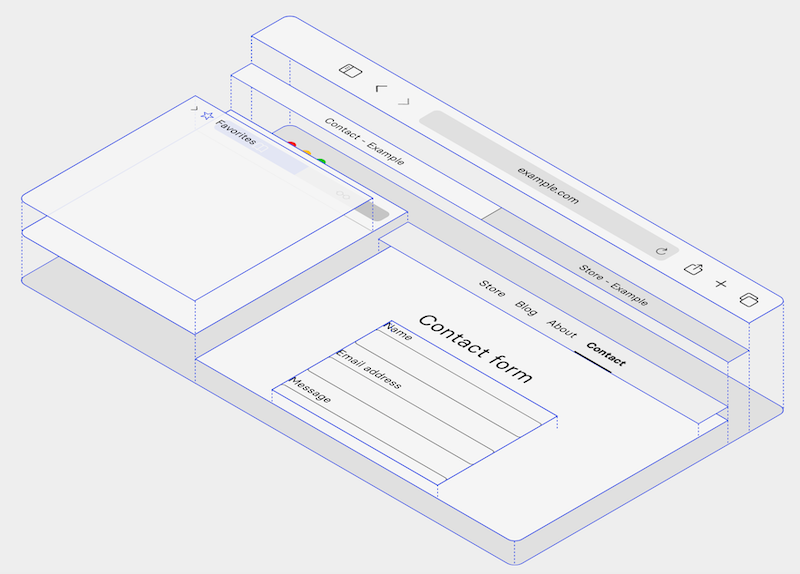
    Illustration of how related elements in the browser window are grouped together. Credit: yakim.nl

    How to start testing screen reader support using VoiceOver

    • Article by Yakim van Zuijlen, describing how to use VoiceOver on a Mac to test your website. It’s aimed at beginners, but goes into quite a lot of detail, including how to find items by type (e.g. blockquote). There are some beautiful, clear illustrations throughout the article, showing which keys to press to trigger shortcuts, or how elements in the browser are grouped together by VoiceOver.

    Prefer longer newsletters? You can subscribe to week11y, fortnight11y or even month11y updates! Every newsletter gets the same content; it is your choice to have short, regular emails or longer, less frequent ones. Curated with ♥ by developer @ChrisBAshton.

  • dai11y 23/02/2021

    Your daily frequent11y newsletter, brought to you by @ChrisBAshton:

    12 Common Words and Phrases You May Not Realise Are Ableist

    • Some of these seem fairly obvious, but others less so. With respect to autism, “high or low functioning” is an ableist term I hadn’t considered. ‘Differently abled’ and ‘special needs’ are also poor euphemisms for the term ‘disabled’. ‘Tone deaf’ and ‘blind spot’ are also terms in common usage, but which harmfully link deafness/blindness with ignorance.
    • The other phrases this article considers ableist are ‘imbecile’, ‘crippled’, ‘spastic’, ‘lame’, ‘suffering’ (as in “suffering from [disability]”), ‘wheelchair bound’ (in reality, many wheelchair users find their wheelchairs liberating) and finally, a saying I hadn’t heard before: “See the Able, Not the Label”.

    Prefer longer newsletters? You can subscribe to week11y, fortnight11y or even month11y updates! Every newsletter gets the same content; it is your choice to have short, regular emails or longer, less frequent ones. Curated with ♥ by developer @ChrisBAshton.

  • dai11y 22/02/2021

    Your daily frequent11y newsletter, brought to you by @ChrisBAshton:

    ProPublica experiments with ultra-accessible plain language in stories about people with disabilities

    Prefer longer newsletters? You can subscribe to week11y, fortnight11y or even month11y updates! Every newsletter gets the same content; it is your choice to have short, regular emails or longer, less frequent ones. Curated with ♥ by developer @ChrisBAshton.

  • dai11y 19/02/2021

    Your daily frequent11y newsletter, brought to you by @ChrisBAshton:

    Accessibility auditing and ego

    • A very popular article among a11y newsletters at the moment. Eric Bailey reminds us that WCAG is a standard, that sets “objective criteria for what is and is not accessible”. In other words, you might hate the design of a website, but it might conform to all WCAG criteria. Don’t creatively reinterpret what a Service Criterion says to fit your agenda.
    • As a designer, you can appeal to a product’s usability, giving subjective feedback grounded in objective origins. But in an auditing context, you have to kill your ego and only point out failures that map to WCAG rules.
    • Eric says you should think like a lawyer: every call you make might have to be defended in a court of law [it’s worth noting that this article is written from an American point of view]. That is to say, “stay in your lane”, by sticking to established, legally accepted parameters, i.e. WCAG.

    Prefer longer newsletters? You can subscribe to week11y, fortnight11y or even month11y updates! Every newsletter gets the same content; it is your choice to have short, regular emails or longer, less frequent ones. Curated with ♥ by developer @ChrisBAshton.

  • dai11y 18/02/2021

    Your daily frequent11y newsletter, brought to you by @ChrisBAshton:

    Infinite Scroll: What Is It Good For?

    • Article exploring the pros and cons of infinite scroll. The pros were simply “seamless mobile scrolling” and “serendipitous browsing”. The cons were numerous:
      • Could contribute to social media addiction.
      • Might make sidebars and other content inaccessible to assistive technology users.
      • Makes footers impossible to reach.
      • Causes users to lose their place (especially when hitting the ‘Back’ button).
      • Slows down users who have specific goals (e.g. wanting to jump to a letter midway through the alphabet).
    • Tips to improve infinite scroll implementations:
      • Don’t place content below the infinite scroll.
      • Code in some logic to allow ‘Back’ interactions to keep their place.
      • Let user skip to particular numbers/letters.
      • Ensure it works for keyboard users.

    Prefer longer newsletters? You can subscribe to week11y, fortnight11y or even month11y updates! Every newsletter gets the same content; it is your choice to have short, regular emails or longer, less frequent ones. Curated with ♥ by developer @ChrisBAshton.

  • dai11y 17/02/2021

    Your daily frequent11y newsletter, brought to you by @ChrisBAshton:

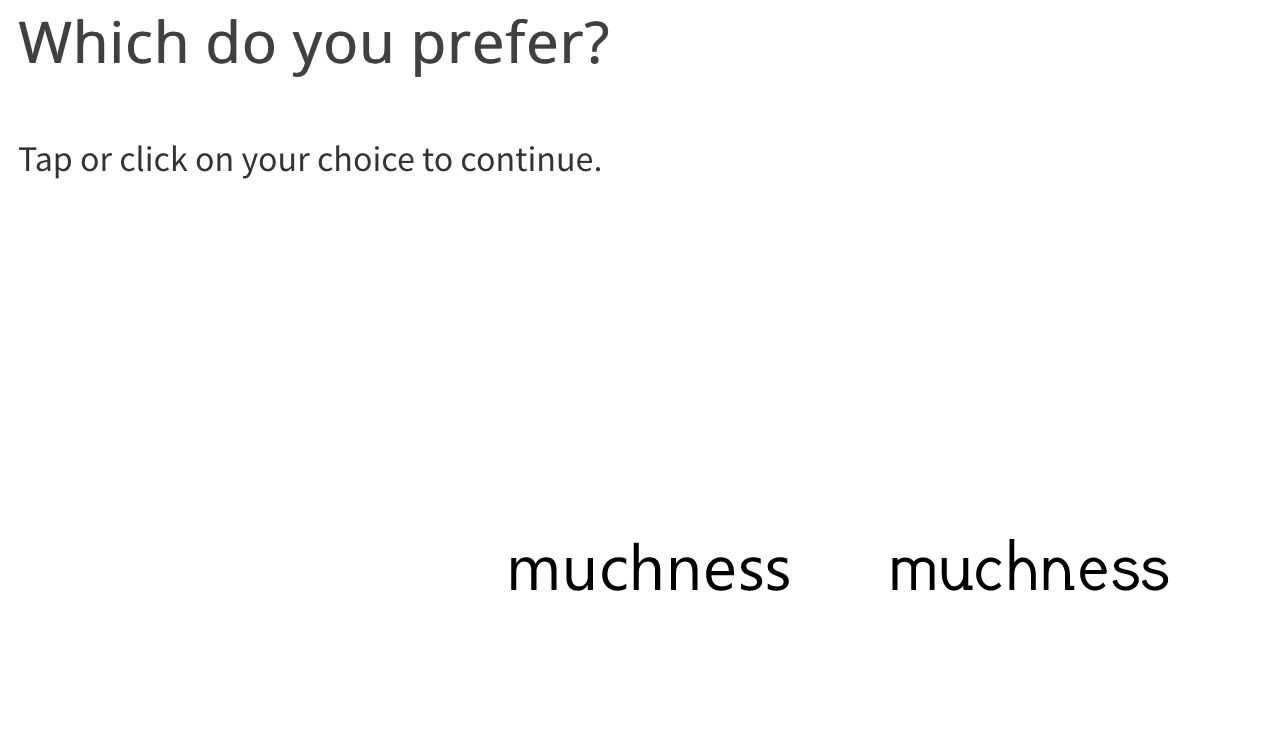
    Screenshot of survey question: "Which do you prefer?", with a choice of two fonts.
    Screenshot from The Readability Group’s survey

    The Readability Group – Survey

    • The Readability Group is a collection of experts in design and accessibility. Their mission is to “optimise typographic accessibility by providing expert advice based on data, not anecdote”. Essentially, they want to gather real user feedback on the readability of typography.
    • Please take around twenty minutes of time to contribute to the “Readability survey”, which has been nearly 2 years in development!

    Prefer longer newsletters? You can subscribe to week11y, fortnight11y or even month11y updates! Every newsletter gets the same content; it is your choice to have short, regular emails or longer, less frequent ones. Curated with ♥ by developer @ChrisBAshton.

  • dai11y 16/02/2021

    Your daily frequent11y newsletter, brought to you by @ChrisBAshton:

    Glove translates sign language in real-time – ’99 percent recognition rate’

    • A Daily Express article from last summer. Bioengineers at the University of California have developed a glove that can translate sign language into speech in real-time, using an accompanying smartphone app.
    • The glove has thin sensors running to the fingertips, which can detect motions. The smartphone app uses a custom machine learning algorithm to convert the gestures into letters, numbers and words, and can recognise 660 signs. It translates at a speed of one word per second, with an accuracy rate of 98.63%.
    • The glove has its critics. Gabrielle Hodge, a deaf researcher at University College London, says: “there is nothing wrong with [sign language as a] form of communication” and that the technology is “redundant”, due to deaf signers already making extensive use of text-to-speech software.

    Prefer longer newsletters? You can subscribe to week11y, fortnight11y or even month11y updates! Every newsletter gets the same content; it is your choice to have short, regular emails or longer, less frequent ones. Curated with ♥ by developer @ChrisBAshton.