Category: week11y

Accessibility themed newsletter released every week.

  • week11y issue 17

    Your weekly frequent11y newsletter, brought to you by @ChrisBAshton:

    ‘Show Me a Sign’ recounts the deaf experience for young readers

    • MV Times article from last December, describing Ann Clare Le Zotte‘s new novel “Show me a Sign”, which is now available online. It is set in early 19th century Chilmark, Massachusetts – a town famous for its unusually high percentage of deaf citizens (one in 25 people, vs one in 6000 on the mainland). Everyone could communicate with one another, deaf or not, through Martha’s Vineyard Sign Language (MVSL). It sounds like an exciting read, centered around a scientist that uses Mary as a “live specimen” in a cruel experiment, tribal/colonial tensions of the time, and an insight into how Mary lives without sound.

    Why the GOV.UK Design System team changed the input type for numbers

    • Article by Hanna Laakso, explaining why GOV.UK has moved away from using <input type="number"> for things like credit card / passport numbers. It has big issues in NVDA and Dragon Naturally Speaking, and its native increment/decrement behaviour (triggered by UP/DOWN arrow keys or scrolling) is often unintended. Some browsers also attempt to round the number or add comma separation. GOV.UK now uses <input type="text" inputmode="numeric" pattern="[0-9]*">, which retains the numeric keyboard without compromising usability.

    7 users share their struggles navigating the (sometimes inaccessible) digital world

    • Real users with disabilities sum up their biggest struggles with the digital world. Robert (who has a visual impairment) struggles with date inputs where websites don’t let you enter the date manually, forcing him to navigate an often inaccessible calendar. Rhian, who is autistic, shares her frustration with auto-playing videos and poor website load speeds. Sally, who has a mobility impairment, says that increasing font sizes is hard in apps, and that zooming causes its own problems. Kasia needs someone’s assistance when online shopping, as they don’t feel comfortable sharing their bank details on inaccessible sites where it is difficult to know if they’re filling it in correctly. Several complain about CAPTCHA forms that force you to prove you’re not a robot.

    Could browsers fix more accessibility problems automatically?

    • Whilst web developers/designers have a duty to make their website accessible, many simply don’t – be it through lack of awareness, skills, resources or empathy. Hidde de Vries proposes that browsers bridge the gap by providing ways of forcing colour contrasts, focus states, text sizes, disabling autoplay and allowing zoom, even if a developer has explicitly disabled such features. Some browsers do some (but not all) of this already, and what does exist is not easily discoverable.

    Did you know that you can subscribe to dai11y, week11y, fortnight11y or month11y updates! Every newsletter gets the same content; it is your choice to have short, regular emails or longer, less frequent ones. Curated with ♥ by developer @ChrisBAshton.
  • week11y issue 16

    I’m going on holiday next week, so the next edition of week11y will likely be Monday 9th March!


    Apple debuts ‘head pointer’ accessibility feature in macOS beta, a cursor that follows your eyes

    Make your PowerPoint presentations accessible to people with disabilities

    • A Microsoft guide to ensuring your PowerPoint is accessible. A lot of the guidance is the same as it would be for the web: use descriptive links, don’t use colour alone to convey information, use a decent size text, provide alt text for images. Some more specialist advice includes ensuring the reading order of your slide is correct (screen readers will hear content in the order it was added, rather than the position it appears in the slide), and give each slide a unique title.

    These are the standards for new government websites

    • A look at the United States Web Design System (USWDS) released in January, designed to improve the usability and accessibility of federal websites. It encourages focusing on user needs, following user experience guidance and using USWDS components, as per its maturity model. The system meets WCAG 2.0 AA guidelines and follows the 2% rule pioneered by GDS, supporting all major browsers and IE11. The codebase looks very similar to the GOV.UK Design System, with both using Nunjucks and BEM.

    https://whocanuse.com

    • A little look at the “Who Can Use” tool, which takes a text color and background color and shows the accessibility of that combination for various vision types. For example, a #CF0000 red against a white background has AA compliance for regular vision, but AAA compliance for those with achromatomaly (partial colour blindness). What’s particularly useful is the “Simulation” next to each vision types/events, such as showing how your combination might look when viewed in direct sunlight. A worthy tool to have in your arsenal!

    week11y is a weekly newsletter dedicated to all things accessibility, curated by developer @ChrisBAshton. Each resource is summarised as a TLDR, in case you don’t have time to read the actual article. Readers are encouraged to read the linked articles and form their own conclusions.

  • week11y issue 15

    Your weekly frequent11y newsletter, brought to you by @ChrisBAshton:

    The Click-Away Pound Survey 2019

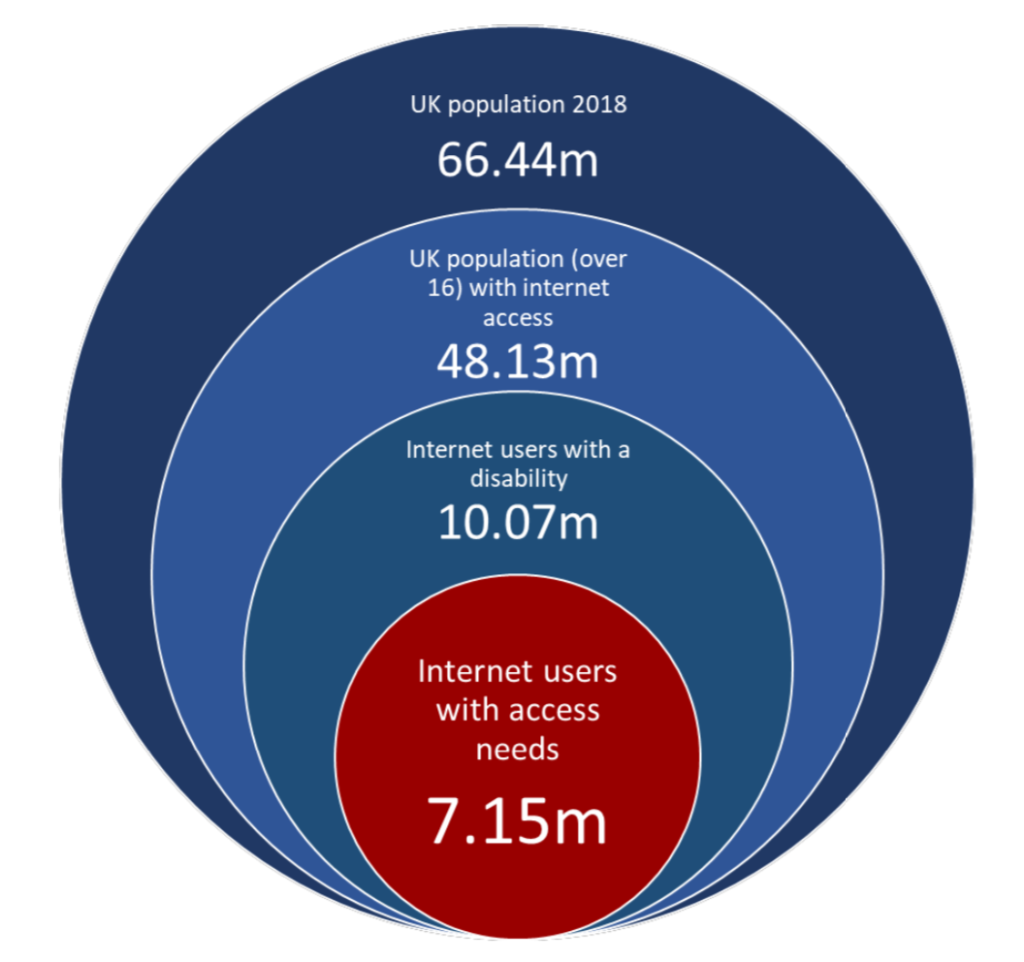
    • This 32 page report (ironically only available as Word/PDF documents) of last year’s survey has some highlights. There are 7.15 million internet users in the UK that have access needs (an increase of 1 million since 2016), with a spending power of £24.8 billion. Around 70% will click away from an inaccessible site, meaning businesses are losing out on £17.1 billion per year. The survey was last run in 2016 and things haven’t improved measurably since then. I’ve attached a graphic from the report that helps show the scale of the problem.
    UK population 2018: 66.44m
UK population (over 16) with internet access: 48.13m
Internet users with a disability: 10.07m
Internet users with access needs: 7.15m
    Source: The Click-Away Pound survey report 2019

    Disproportionate Burden Thoughts

    • A blog post by accessibility consultant George Rhodes, with their views on public organisations’ use of “disproportionate burden” as an excuse to (temporarily) avoid full compliance with the regulations. 60 public sector bodies have claimed disproportionate burden and been asked to provide evidence via Freedom of Information requests. Many of their responses were unsatisfactory.
    • Background: UK public bodies have until September 2020 to ensure compliance with the Public Sector Bodies (Websites and Mobile Applications) (No. 2) Accessibility Regulations 2018. Exemptions will be made for those for whom it would be a ‘disproportionate burden’ on the grounds of organisation size, and cost of fixing vs benefit to users.

    An Accessible Digital BBC – 2019 in review

    Bonjour! ¡Bienvenidos! Seeing AI expands to 5 new languages

    • If you’ve not heard of the “Seeing AI” app from Microsoft, it’s an all-encompassing app that uses your phone’s camera for many things, including reading text, scanning product barcodes for info, recognising faces, and describing the scene in front of you. I hadn’t heard of it prior to this article, which describes its expansion to 5 different languages, and describes the ways real people use it, sometimes in unexpected ways. Download it from the app store and give it a try today!

    Did you know that you can subscribe to dai11y, week11y, fortnight11y or month11y updates! Every newsletter gets the same content; it is your choice to have short, regular emails or longer, less frequent ones. Curated with ♥ by developer @ChrisBAshton.
  • week11y issue 14

    Your weekly frequent11y newsletter, brought to you by @ChrisBAshton:

    But first, an announcement: Government Digital Service is hiring a Head of Accessibility to be a “thought leader and champion of accessible and inclusive services”. Applications close on 25th February 2020 at midnight.


    Memes Are Still Inaccessible to the Blind

    • Time article sharing the impact of memes being unreadable to the blind. Accessibility is often about providing the bare essentials – making the workplace or transportation accessible – whereas leisure or silly activities are overlooked. The result is a lack of inclusivity, with many unable to join in the conversation. Researchers are experimenting with using AI to identify memes via templates, and rendering these memes in less deadpan ways than your typical screen reader. For instance, “success kid” would have the beginning of the meme, then upbeat dance music speeding up to a triumphant finish.

    The Universal Page

    • An article about the history of braille, and its early competitors (Boston Line Type). By the 1860s there were a number of competing standards – leading to the “War of the Dots” in 1909, where braille was the standard of choice for the New York Board of Education for its blind schools. Other attempts at enabling blind access to books is the optophone; a scanner that looks at text and converts it into tones representing the shapes of the letters. In theory, mastering the optophone enables the reading of any book; in practice, it’s incredibly difficult to interpret. It’s well worth seeing it in practice.

    When to Open Links in a New Tab

    • A short article by Jens Oliver Meiert, with one simple summary: “Always open links in the same tab unless doing so 1) could disrupt a process, 2) could risk data loss, or 3) could confuse the user.” He gives examples of opening PDFs (which should be opened in a new tab, after warning the user), as they are in a non-native environment. He also cites Jakob’s Law: “users spend most of their time on other sites; they prefer your site to work the same way as the sites they already know.” Opening external links in new tabs to increase likelihood of ‘conversion’ is misguided advice and provides a poor UX.

    Money in my account, but still can’t pay: Winner of ‘best accessible website’

    • Nidhi Goyal‘s website, Rising Flame, won India’s “Best Accessible Website 2019” award. This article by The Indian Express doesn’t talk about the site (though I highly recommend visiting it and trying its accessibility features) – instead, it talks about how Goyal’s success still does not allow her to fully participate in society. Goyal, who is blind, may have money but she can’t use certain payment platforms to pay for things as they provide a broken screen reader experience. She flies long distance as part of her work, but is unable to use a call bell on flights because they’re on touch screen panels. Goyal says the reason the world lacks universal design is that people don’t yet see the disabled as customers or decision-makers.

    Did you know that you can subscribe to dai11y, week11y, fortnight11y or month11y updates! Every newsletter gets the same content; it is your choice to have short, regular emails or longer, less frequent ones. Curated with ♥ by developer @ChrisBAshton.

  • week11y issue 13

    Your weekly frequent11y newsletter, brought to you by @ChrisBAshton:

    Progressive React

    • A surprisingly quick read despite its length: Houssein Djirdeh details several techniques for improving performance and accessibility of React applications. Use pre-rendered or server-side rendered (SSR) React, ideally hydrated in Node ‘streams’ rather than en-masse. Use streams for extracting critical CSS too. Various DevTools profilers help identify unnecessary component re-renders: override shouldComponentUpdate or inherit from PureComponent to mitigate. Split components with React.lazy (or with a library like loadable-components if SSR’d). A worthy read if you ever dabble with React.

    Why GOV.UK content should be published in HTML and not PDF

    • A GOV.UK article from 2018 that is still relevant today. It highlights the problems with PDFs (not designed for screens – particularly on mobile, hard to track and to update, and often inaccessible to assistive technology) whilst acknowledging their advantages (control over design, easy to create from many applications, predictable printing behaviour). The comments are worth reading too: some argue that static PDFs are better than dynamic HTML for archival reasons, as well as easier offline access that doesn’t require “Print to PDF” technical knowledge. These are areas GOV.UK could do better at while still advocating for a HTML-first approach.

    aria-label Does Not Translate

    • Interesting post by Adrian Roselli, highlighting that for users who rely on built-in translation services in their browser, aria-label markup often isn’t translated. For this reason he recommends tweaking your design to use native HTML (label, etc), or otherwise using visually hidden text or aria-labelledby which do not have the same issues with auto-translating. He also highlights a new aria-description property that is coming to ARIA, which solves the messiness of aria-labelledby requiring additional nodes in the DOM that could be accidentally read out twice. However, it will have the same translation issue as aria-label until auto-translators get better.

    How Glasgow’s clubs try to be accessible for everyone

    • Not necessarily what you’re expecting to read from the title (it’s not all “installing a lift for wheelchair users”, writes Kamila Rymajdo). Kamila highlights the efforts a number of clubs are making to become more inclusive spaces for the LGBTQ community, such as briefing clubbers at the door about what the night celebrates (including financial assistance for travel and reduced entry fees for some), and a representative present throughout the night for people to talk to if they are encounter any problems. Others are taking steps to not dim lights to an uncomfortable degree, to have visuals that are suitable for epileptic individuals, and to always have somewhere to sit and water visibly available.

    Did you know that you can subscribe to dai11y, week11y, fortnight11y or month11y updates! Every newsletter gets the same content; it is your choice to have short, regular emails or longer, less frequent ones. Curated with ♥ by developer @ChrisBAshton.

  • week11y issue 12

    Your weekly frequent11y newsletter, brought to you by @ChrisBAshton:

    How I’m making Maps better for wheelchair users like me

    • Article by Google employee Sasha Blair-Goldensohn, talking about the role he’s played in making the world more accessible to the 65 million wheelchair users worldwide. In his “20% time”, Sasha and other colleagues launched ‘wheelchair-friendly transit directions’ for Google Maps, and worked with the 120 million-strong Local Guides community to crowdsource answers about the accessibility of venues. This initial work has led to a full time team dedicated to accessibility on Maps. He also talks about the curb-cut effect, or ‘universal design’, whereby wheelchair-accessible exits from pavements benefit others such as parents pushing strollers, or tourists pulling suitcases.

    How to Create Printer-friendly Pages with CSS

    • Article by Craig Buckler, packed with tips on how to improve your website’s print styles; something often overlooked even by a11y-aware devs. I guarantee you’ll learn something new: there are various techniques for avoiding wasting ink. You can automatically add supplementary content such as URLs after links using pure CSS, or print-only content such as copyright messages. You can define page breaks using break-before, break-after or break-inside. You can limit the number of lines of text that carry over to the next page with widows and orphans properties, and control how an element’s border renders when it’s split across multiple pages (box-decoration-break) . Finally, @page selectors and targets allow you to adjust margins on a per-page basis.

    Facts & Figures: Disabilities in developing countries

    • An estimated 1 billion people in the world (15% of the population) live with a disability. 80% of these are in developing countries. 3 percent experience ‘severe disability’ and cannot manage daily life without assistance. Defining & measuring disability is difficult worldwide, with mental health conditions particularly under-reported. Under-reporting is driven by stigma; for example, just 2.2% of Indian residents claim to have a disability whereas the World Health Survey estimates it to be 25%. Disability figures are rising worldwide as a result of aging populations and an increase in chronic health conditions.

    Deaf man sues Pornhub over lack of closed captions

    • Yaroslav Suris, from New York, is suing Pornhub, RedTube and YouPorn for allegedly violating the 1990 Americans with Disabilities Act (ADA) by not providing closed captions on its videos, on either its free or premium access. Pornhub responds that it has had closed captioning on some of its videos since 2018, and offers a closed caption ‘category’, however concedes that it is not available for the majority of its content.

    Did you know that you can subscribe to dai11y, week11y, fortnight11y or month11y updates! Every newsletter gets the same content; it is your choice to have short, regular emails or longer, less frequent ones. Curated with ♥ by developer @ChrisBAshton.

  • week11y issue 11

    Your weekly frequent11y newsletter, brought to you by @ChrisBAshton:

    Gaming Needs Some Basic Accessibility Improvements in 2020

    • Article by Laura Dale, explaining some of the most commonly requested accessibility features for console gaming (controls remapping, colour blindness support and the ability to adjust text size). A cautionary note about the new PS5 controller, which will have a “resistive trigger” (become harder to press under certain conditions), which allows game creators to mimic pulling harder against a bow string to shoot arrows further, for example. This feature could be a great immersive tool, but does risk alienating some players who may find it painful to use – watch this space. Finally, a note about VR, which is currently inherently inaccessible to many; a situation that is unlikely to improve much in 2020.

    How to Use AirPods as Hearing Aids

    • Step by step instructions from OSXDaily, walking through adding the ‘Hearing’ control to your iPhone’s control centre and connecting it to your AirPods. Once connected, you can use the ‘Live Listen’ feature to amplify your surroundings directly into your ears, positioning your iPhone near whatever it is you’re having trouble hearing. Apple is quick to point out that this is no replacement for hearing aids, but the technology is certainly improving and there are people in the comments hoping that AirPods could prove to be a high quality, low-cost solution in the long term.

    Training people to do accessibility reviews

    • GOV.UK blog post by Beverly Newing, describing how she led accessibility testing training at the Ministry of Justice. She created a fake government service and made it deliberately inaccessible, with an accompanying worksheet and answers that can be covered in a one hour session. Interestingly, Beverly has added some impeding issues that wouldn’t be considered WCAG failures, to hit home that WCAG compliance does not guarantee an accessible service.

    What’s more expensive than getting sued over inaccessibility?

    • The answer: “getting sued twice”. This US-focused article by Sheri Byrne-Haber follows a report showing that 21-40% of accessibility lawsuits are against companies which have been previously sued. The author suggests that this is because companies may fix problems but then don’t build accessibility testing into their ongoing process, so problems inevitably creep back in. It’s also down to the “Hooters effect”; a decision in Haynes vs Hooters shows that other individuals can sue your organisation even while the first lawsuit is being investigated or the fixes are in the process of being implemented.

    Did you know that you can subscribe to dai11y, week11y, fortnight11y or month11y updates! Every newsletter gets the same content; it is your choice to have short, regular emails or longer, less frequent ones. Curated with ♥ by developer @ChrisBAshton.

  • week11y issue 10

    Your weekly frequent11y newsletter, brought to you by @ChrisBAshton:

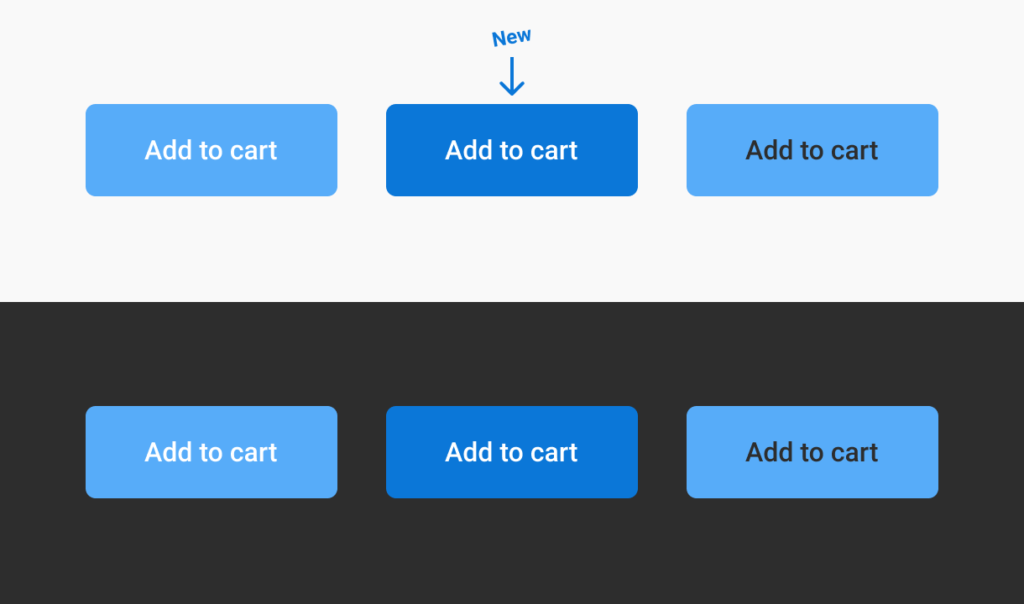
    New button has slightly darker blue and works better on both white and black backgrounds, compared to the original two buttons.
    Geoffrey’s proposed color contrast scored highly with users and has a AA rating for contrast

    There is no “Myths of Color Contrast Accessibility”

    • A UX Movement article (covered in November) argued that text/background color combinations that fail the WCAG AA contrast threshold can actually be easier to read than those that pass. Geoffrey Crofte has written a counter-article arguing that the methodology of the original article was flawed, proposing his own combo (via useful tool color.review) that is both AA-compliant and is easier to read than the original. It’s worth noting the new contrast rating (4.5) is still lower than the ‘hard to read, but compliant’ original (5.41), but Geoffrey puts this down to context: a black background reverses the perception biases of the original article. Finally, Geoffrey disagrees that color alone can be used to denote state (see myth 6 in the original article), arguing that the toggle token example is difficult to read if no tokens are toggled by default.

    Leonardo: an open source contrast-based color generator

    • An in-depth article about leonardocolor.io, a tool that helps you to find colour palettes that conform to the WCAG AA contrast guidelines. It explains the different interpolation algorithms in more detail than I was able to digest, but the really intriguing idea is one of using the NPM module to generate accessible palettes in real time, dynamically in your web app, allowing users to adjust the brightness and contrast of your site’s theme colours to suit their vision. See the demo.

    This advocate redesigned the disability royal commission website so people with a disability can actually use it

    • The Australian Disability Royal Commission website leaves a lot to be desired: overly long, with legal jargon, and a 35-page submission form that required installing Adobe Acrobat before getting started, it was ironically quite inaccessible. Campaigner Sam Connor stayed up one night to build an unofficial, accessible alternative to the government site, signalling their frustration and showing how simple it can be made. A redesign of the official site – and streamlining of the submission process – is purportedly in the works.

    If you ARIA label something, give it a role

    • Article by Marco Zehe, advising that any time you use an aria-label or aria-labelledby attribute, you must also give the thing a role. He suggests that a label without a role is harder to understand: “a div with an aria-label is much more meaningful if it is clear that it groups some elements together [by also adding role=’group’]”. What’s interesting is his prediction that the spec will change in future to disallow any aria-label that does not also have a role, forcing developers to mark up their pages correctly.

    Access all areas – inside GDS’s accessibility empathy lab

    • A Civil Service World article about the GDS empathy lab comprised of laptops, tablets and phones running assistive technology (and simulated ‘personas’ covered in another GOV.UK blog post), that is available for use by developers at GDS and in the Civil Service. The lab has had around 500 visitors since September 2018, and Head of Accessibility Richard Morton has given introductions to accessibility to 400 people in that time. The next step will be to have a “mini empathy lab” by GDS reception to raise awareness even more prominently.

    Did you know that you can subscribe to dai11y, week11y, fortnight11y or month11y updates! Every newsletter gets the same content; it is your choice to have short, regular emails or longer, less frequent ones. Curated with ♥ by developer @ChrisBAshton.

  • week11y issue 9

    Your weekly frequent11y newsletter, brought to you by @ChrisBAshton:

    7 Predictions for Accessibility in 2020 and Beyond

    • A UsableNet article that is full of optimism for the future: Jason Taylor predicts that a rise in a11y-related lawsuits will drive a more proactive approach to building accessible websites. Companies will no longer settle for agency-built sites or CMS templates that are inaccessible, and many will hire a11y experts to ensure compliance. E-commerce sites and the web in general will become more accessible in 2020 as a result.

    Responsive Type and Zoom

    • Article by Adrian Roselli, warning about a responsive typography implementation which cleverly resizes font size according to viewport width, but does not take into account browser zoom (which is an issue for a11y). Adrian compares it with his own CodePen, which does not resize based on viewport width but does cope with browser zooming. He implies that both might be accomplished by using %, em or rem instead of px in the first example, but doesn’t provide a solution. One thing I learned/re-remembered was that we should use pt units for print styles.

    New Library Is a $41.5 Million Masterpiece. But About Those Stairs.

    • A New York Times piece by Sharon Otterman. The newly built Hunters Point Library in Long Island City, New York, is a purpose-built open-plan building with ampitheatre-like seating throughout. But it has only one elevator, which is a bottleneck at peak times: parents and minders struggle to get their prams upstairs in time for “toddler story time”. Stair-based child seating areas were also deemed unsafe and have since been blocked off, to be reopened again after a refit. Disabled adults were encouraged to ask staff to fetch specific books rather than be able to freely browse the aisles accessible only by staircase. A physical embodiment of what can happen if we design for visual splendor over function.

    Scientist regrow ear hairs in discovery which paves the way for a deafness cure

    • A research team at Harvard University have successfully ‘reprogrammed’ the inner ear cells of mice to divide and become hair cells, which are used for hearing. Previous research had already accomplished cell regeneration, but this was the first time in ‘fully mature’ ears. Whilst a cure for deafness is a long way off, this is a promising foundation for further research that could also serve as a model to regenerate “other tissues such as in the retina and central nervous system” – perhaps curing many other conditions!

    Did you know that you can subscribe to dai11y, week11y, fortnight11y or month11y updates! Every newsletter gets the same content; it is your choice to have short, regular emails or longer, less frequent ones. Curated with ♥ by developer @ChrisBAshton.

  • week11y issue 8

    Your weekly frequent11y newsletter, brought to you by @ChrisBAshton:

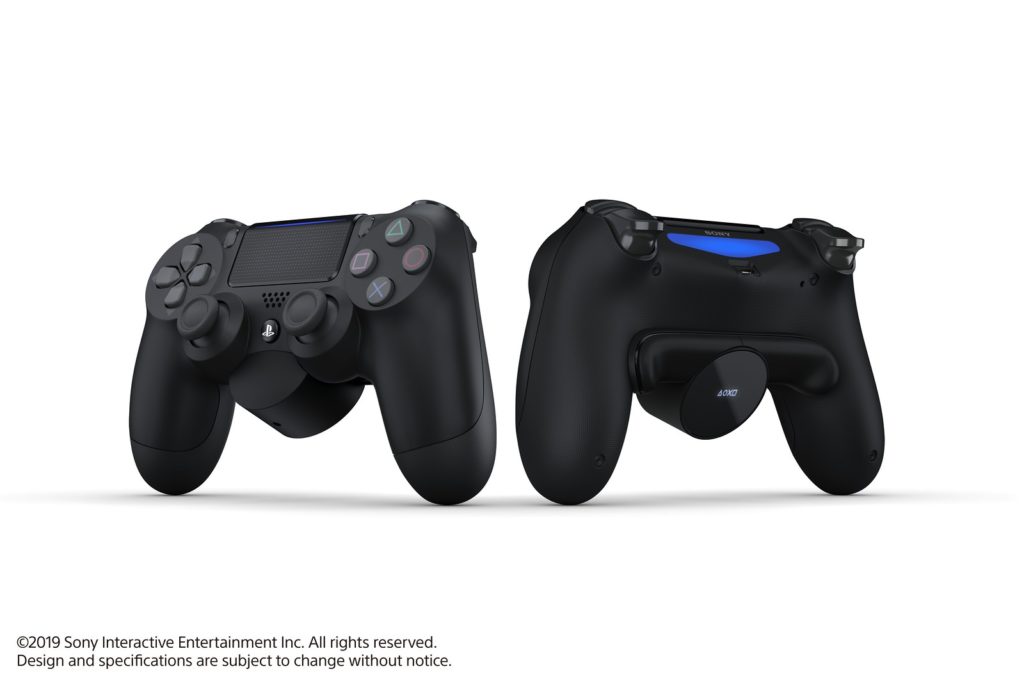
    Image of the new attachment for the DualShock controller. Copyright Sony Interactive Entertainment Inc. All rights reserved. Design and specifications are subject to change without notice.

    Sony’s new Back Button Attachment brings customizable paddles to the DualShock 4

    • Sony are releasing a $30 attachment for the DualShock 4 controller which slots into the back and provides two extra large buttons. These can be mapped to any of the other buttons on the controller, and could be a (literal) game changer for disabled users who may struggle to use the controller standalone. It’s not being marketed as an accessibility aid, but as a tool for power users to level up their gameplay. Indeed, non-disabled users could find the tactile buttons improve their gaming performance.
    • Aside: It’s highly unusual for Sony to release something like this so late in the PS4 lifecycle, which suggests these might work with the DualShock 5 when it comes out.

    Epilepsy Foundation Bombarded with Seizure-Triggering Twitter Posts

    • The Epilepsy Foundation has filed a criminal complaint with the U.S. Attorney and the Office of the State’s Attorney in Maryland, against a number of Twitter uses who maliciously posted seizure-inducing content on its feed. This happened during November: National Epilepsy Awareness month. A similar attack happened in 2016 against journalist Kurt Eichenwald, which purportedly triggered a seizure.
    • Aside: around 3% of people with epilepsy can be triggered by exposure to flashing lights or certain visual patterns.

    Accessibility Testing by People with Disabilities

    • An article of two halves, by a11y expert Becky Gibson. The first half gives guidance for performing your own a11y audit. It recommends WAVE as a starting point, followed by the Web Developer extension for validating document structure and numerous bookmarklets for additional automated tests. This is followed by manual keyboard and screen reader testing – checking for WCAG 2.1 AA violations (as opposed to WCAG 2.0, which was released in 2008 and has little guidance for mobile) – and finally, testing responsive design and zoom/magnification. The second half highlights Vision Aid for specialising in training blind individuals as testers, and argues the business case for this (‘native’ screen reader users will spot problems more quickly and catch some issues that other testers might not).

    Did you know that you can subscribe to dai11y, week11y, fortnight11y or month11y updates! Every newsletter gets the same content; it is your choice to have short, regular emails or longer, less frequent ones. Curated with ♥ by developer @ChrisBAshton.