Category: dai11y

Accessibility themed newsletter: get your daily dose of a11y.

  • dai11y 19/02/2020

    Your daily frequent11y newsletter, brought to you by @ChrisBAshton:

    Make your PowerPoint presentations accessible to people with disabilities

    • A Microsoft guide to ensuring your PowerPoint is accessible. A lot of the guidance is the same as it would be for the web: use descriptive links, don’t use colour alone to convey information, use a decent size text, provide alt text for images. Some more specialist advice includes ensuring the reading order of your slide is correct (screen readers will hear content in the order it was added, rather than the position it appears in the slide), and give each slide a unique title.

    Prefer longer newsletters? You can subscribe to week11y, fortnight11y or even month11y updates! Every newsletter gets the same content; it is your choice to have short, regular emails or longer, less frequent ones. Curated with ♥ by developer @ChrisBAshton.
  • dai11y 18/02/2020

    Your daily frequent11y newsletter, brought to you by @ChrisBAshton:

    Apple debuts ‘head pointer’ accessibility feature in macOS beta, a cursor that follows your eyes

    Prefer longer newsletters? You can subscribe to week11y, fortnight11y or even month11y updates! Every newsletter gets the same content; it is your choice to have short, regular emails or longer, less frequent ones. Curated with ♥ by developer @ChrisBAshton.

  • dai11y 17/02/2020

    Your daily frequent11y newsletter, brought to you by @ChrisBAshton:

    Bonjour! ¡Bienvenidos! Seeing AI expands to 5 new languages

    • If you’ve not heard of the “Seeing AI” app from Microsoft, it’s an all-encompassing app that uses your phone’s camera for many things, including reading text, scanning product barcodes for info, recognising faces, and describing the scene in front of you. I hadn’t heard of it prior to this article, which describes its expansion to 5 different languages, and describes the ways real people use it, sometimes in unexpected ways. Download it from the app store and give it a try today!

    Prefer longer newsletters? You can subscribe to week11y, fortnight11y or even month11y updates! Every newsletter gets the same content; it is your choice to have short, regular emails or longer, less frequent ones. Curated with ♥ by developer @ChrisBAshton.

  • dai11y 13/02/2020

    Your daily frequent11y newsletter, brought to you by @ChrisBAshton:

    An Accessible Digital BBC – 2019 in review

    Prefer longer newsletters? You can subscribe to week11y, fortnight11y or even month11y updates! Every newsletter gets the same content; it is your choice to have short, regular emails or longer, less frequent ones. Curated with ♥ by developer @ChrisBAshton.

  • dai11y 12/02/2020

    Your daily frequent11y newsletter, brought to you by @ChrisBAshton:

    Disproportionate Burden Thoughts

    • A blog post by accessibility consultant George Rhodes, with their views on public organisations’ use of “disproportionate burden” as an excuse to (temporarily) avoid full compliance with the regulations. 60 public sector bodies have claimed disproportionate burden and been asked to provide evidence via Freedom of Information requests. Many of their responses were unsatisfactory.
    • Background: UK public bodies have until September 2020 to ensure compliance with the Public Sector Bodies (Websites and Mobile Applications) (No. 2) Accessibility Regulations 2018. Exemptions will be made for those for whom it would be a ‘disproportionate burden’ on the grounds of organisation size, and cost of fixing vs benefit to users.

    Prefer longer newsletters? You can subscribe to week11y, fortnight11y or even month11y updates! Every newsletter gets the same content; it is your choice to have short, regular emails or longer, less frequent ones. Curated with ♥ by developer @ChrisBAshton.

  • dai11y 11/02/2020

    Your daily frequent11y newsletter, brought to you by @ChrisBAshton:

    The Click-Away Pound Survey 2019

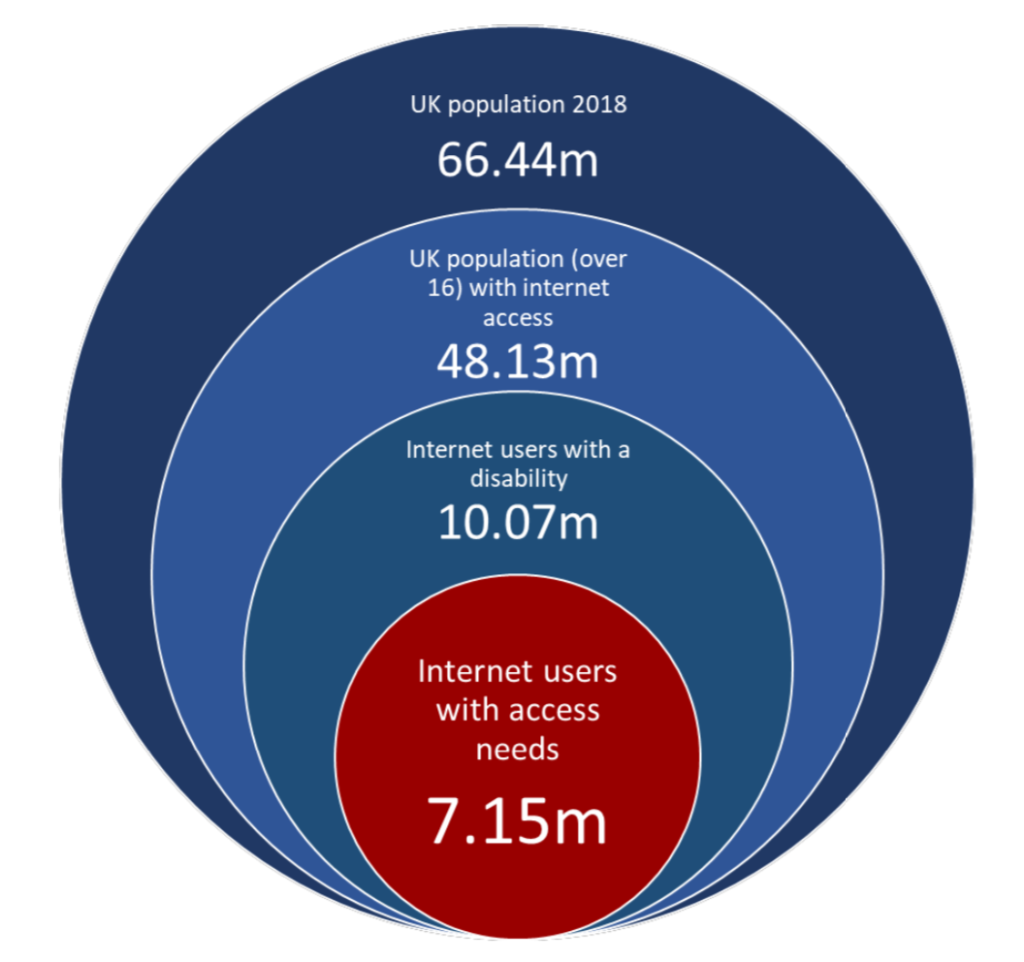
    • This 32 page report (ironically only available as Word/PDF documents) of last year’s survey has some highlights. There are 7.15 million internet users in the UK that have access needs (an increase of 1 million since 2016), with a spending power of £24.8 billion. Around 70% will click away from an inaccessible site, meaning businesses are losing out on £17.1 billion per year. The survey was last run in 2016 and things haven’t improved measurably since then. I’ve attached a graphic from the report that helps show the scale of the problem.
    UK population 2018: 66.44m
UK population (over 16) with internet access: 48.13m
Internet users with a disability: 10.07m
Internet users with access needs: 7.15m
    Source: The Click-Away Pound survey report 2019
  • dai11y 07/02/2020

    Your daily frequent11y newsletter, brought to you by @ChrisBAshton:

    Money in my account, but still can’t pay: Winner of ‘best accessible website’

    • Nidhi Goyal‘s website, Rising Flame, won India’s “Best Accessible Website 2019” award. This article by The Indian Express doesn’t talk about the site (though I highly recommend visiting it and trying its accessibility features) – instead, it talks about how Goyal’s success still does not allow her to fully participate in society. Goyal, who is blind, may have money but she can’t use certain payment platforms to pay for things as they provide a broken screen reader experience. She flies long distance as part of her work, but is unable to use a call bell on flights because they’re on touch screen panels. Goyal says the reason the world lacks universal design is that people don’t yet see the disabled as customers or decision-makers.

    Prefer longer newsletters? You can subscribe to week11y, fortnight11y or even month11y updates! Every newsletter gets the same content; it is your choice to have short, regular emails or longer, less frequent ones. Curated with ♥ by developer @ChrisBAshton.

  • dai11y 06/02/2020

    Your daily frequent11y newsletter, brought to you by @ChrisBAshton:

    When to Open Links in a New Tab

    • A short article by Jens Oliver Meiert, with one simple summary: “Always open links in the same tab unless doing so 1) could disrupt a process, 2) could risk data loss, or 3) could confuse the user.” He gives examples of opening PDFs (which should be opened in a new tab, after warning the user), as they are in a non-native environment. He also cites Jakob’s Law: “users spend most of their time on other sites; they prefer your site to work the same way as the sites they already know.” Opening external links in new tabs to increase likelihood of ‘conversion’ is misguided advice and provides a poor UX.

    Prefer longer newsletters? You can subscribe to week11y, fortnight11y or even month11y updates! Every newsletter gets the same content; it is your choice to have short, regular emails or longer, less frequent ones. Curated with ♥ by developer @ChrisBAshton.

  • dai11y 05/02/2020

    Your daily frequent11y newsletter, brought to you by @ChrisBAshton:

    The Universal Page

    • An article about the history of braille, and its early competitors (Boston Line Type). By the 1860s there were a number of competing standards – leading to the “War of the Dots” in 1909, where braille was the standard of choice for the New York Board of Education for its blind schools. Other attempts at enabling blind access to books is the optophone; a scanner that looks at text and converts it into tones representing the shapes of the letters. In theory, mastering the optophone enables the reading of any book; in practice, it’s incredibly difficult to interpret. It’s well worth seeing it in practice.

    Prefer longer newsletters? You can subscribe to week11y, fortnight11y or even month11y updates! Every newsletter gets the same content; it is your choice to have short, regular emails or longer, less frequent ones. Curated with ♥ by developer @ChrisBAshton.

  • dai11y 04/02/2020

    Your daily frequent11y newsletter, brought to you by @ChrisBAshton:

    Memes Are Still Inaccessible to the Blind

    • Time article sharing the impact of memes being unreadable to the blind. Accessibility is often about providing the bare essentials – making the workplace or transportation accessible – whereas leisure or silly activities are overlooked. The result is a lack of inclusivity, with many unable to join in the conversation. Researchers are experimenting with using AI to identify memes via templates, and rendering these memes in less deadpan ways than your typical screen reader. For instance, “success kid” would have the beginning of the meme, then upbeat dance music speeding up to a triumphant finish.

    Prefer longer newsletters? You can subscribe to week11y, fortnight11y or even month11y updates! Every newsletter gets the same content; it is your choice to have short, regular emails or longer, less frequent ones. Curated with ♥ by developer @ChrisBAshton.